
How I’m Planning Christmas Earlier So I Can Do Less in December
New Here?
My goal is to help driven women build a side hustle and reach goals without sacrificing their family to do it. If that sounds like you, take this steaming cup of coffee, grab some cabin socks and a cozy blanket, and let’s chat a while.
Helpful Resources
- Wondering if you have time for a side hustle? Get the FREE side hustle capacity calculator RIGHT HERE!
- Flexible Weekly Planning System Course Will help you make progress on your to-do list even with constant interruptions. It is possible to make progress towards your goals even when every day looks different. – Check Out The System
I am planning Christmas earlier this year because I want to do less in December.
Not less Christmas.
- Less scrambling.
- Less mental spinning.
- Less last-minute shopping.
- Less wondering what still needs done.
Having a son who is now old enough to really enjoy the season its even more important for him to not see mom stressing over the details.
The feeling of Christmas doesn’t come from running through 47 unfinished tasks in the background of your mind, pushing through the finish line of completion.
The whole point of planning Christmas early is not to be extra organized or impressive. It is to protect mental space. And THAT is at the heart of everything I do.
It’s what affects the holiday season more than almost anything else.
You can do a lot in a season. You can decorate, shop, bake, go to events, serve at church, visit family, make food, wrap gifts, and create really sweet moments.
But what usually makes it feel chaotic is not always the amount of things, it is the not knowing.
It is when your brain is left alone to guess.
- What about gifts?
- What about food?
- What about that family gathering?
- What about church events?
- What about decorations?
- What about stocking stuffers?
- What about wrapping paper?
- What about the thing I said I wanted to do with the kids?
- What about that one person I still do not know what to buy for?
When your mind is spinning, it is hard to feel present.
It is hard to sit with a cozy cup of coffee or read a Christmas book with your child. Or sit in front of the Christmas tree with a warm cup of coffee in hand.
This happens for most of us because our brain keeps trying to solve problems we have not given it a place to put yet.
So I set the plan early. I don’t expect it to work perfectly according to plan. But when I know what the goal is it’s much easier to rearrange the pieces when plans change.
Because I want December to feel like Christmas instead of one long mental spiral.
Christmas Planning Just Got Easier
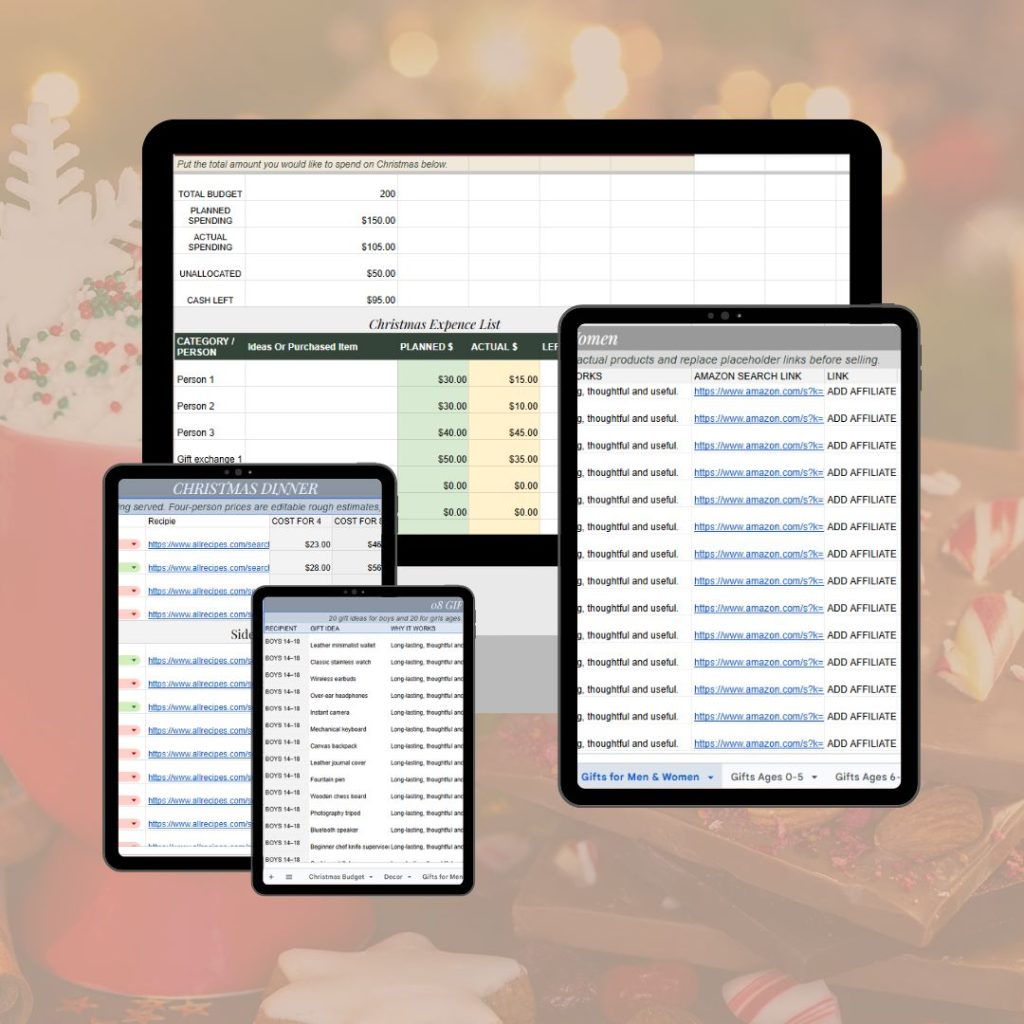
Take the stress out of Christmas with Christmas in a Box, an easy-to-use holiday planning spreadsheet filled with Christmas budgets, gift ideas, decorating inspiration, dinner planning, and more. Everything you need to organize your Christmas in one place!
I Start Planning Christmas in October
It’s not anything crazy but I usually start planning Christmas in October
I start by listing the things that matter most to me and what give us the FEELING of Christmas.
- What makes our home feel like Christmas?
- What gives me the most joy?
- What makes the season feel warm, cozy, peaceful, or special?
- What would I actually miss if it did not happen?
- What decor would I like to change up?
- What new thing do I want to try?
Knowing these things matter because the days and weeks leading up to Christmas fill up FAST.
ACTION ITEM: List the things that create the biggest emotional impact for you.
Life doesn’t stop because it’s Christmas.
There are family gatherings, church events, gifts, meals, decorations, activities, errands, birthdays, shopping trips, and all the normal life things that do not stop just because it is December.
I am still a mom. I am still running two businesses. We still have farm animals. The house still needs managed.
My three-year-old still needs attention.
So I cannot wait until December and assume I will suddenly have unlimited time and energy to make Christmas happen.
I have to plan around the life I actually have.
That is why I start in October with a simple question: What needs to happen early so December can just be enjoyed?
“If you do not want to hold all of Christmas in your head this year, grab the Christmas Planning Checklist. It will help you list the dates, gifts, food, supplies, and simple activities you actually want to make room for before December gets away from you.”
Grab The free Google Doc
Make Christmas easier before December gets here.
The Christmas Prep Checklist gives you a simple month-by-month plan for what to decide, buy, plan, and prepare, plus reminders to skip the things that don’t actually matter to your family.
I Plan Christmas Early to Protect My Mental Space
The biggest reason I plan ahead is my mental capacity. I know what it is like to have a busy brain.
When there is no plan, my brain keeps trying to solve the same problems over and over.
- It throws out ideas at random times.
- It reminds me of things when I cannot actually do anything about them.
- It keeps circling back to unfinished decisions.
And that is exhausting.
But when I have a plan, this happens far less often and I can tell my brain, “We already handled that.”
Even if every detail is not finished, the pieces of Christmas have a plan.
This is what I think a lot of people miss about Christmas planning. Planning ahead is not about controlling every detail and having it work out according to plan. Life doesn’t work like that.
- Someone will add a date.
- Someone will get sick.
- A family member will plan late.
- A kid will need something.
- A church event will shift something.
- The weather may mess with your schedule.
- Something will take longer than you thought.
But when you already have the main pieces written down, you can rearrange them.
You are not starting from mental chaos every time a new piece shows up.

The point of planning early is to give your mind somewhere to put the details so they do not control you.
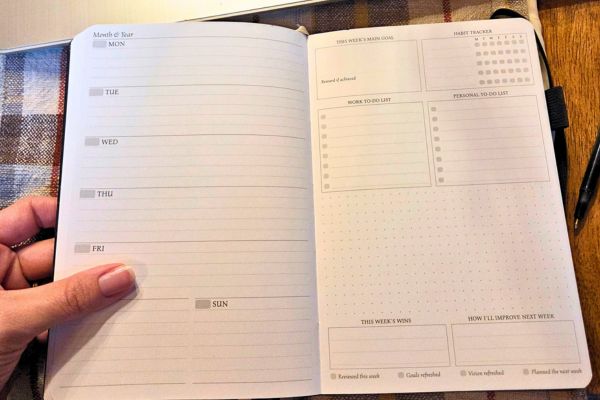
What you use to plan doesn’t really matter. But if you love paper, this planner is currently my favorite.
It is undated, has monthly spreads that also encourage you to bring your goals to the month spread, which helps you choose tasks that get you closer to your goals.
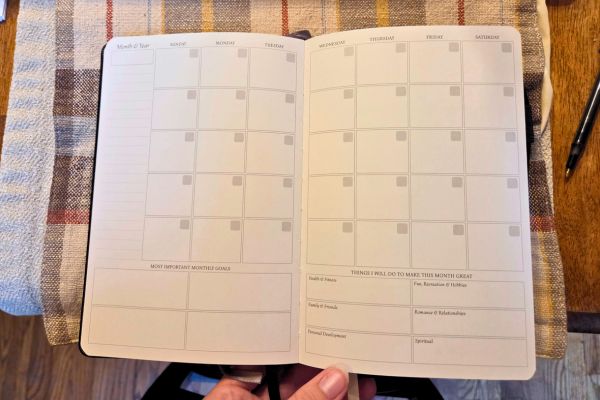
Then the weekly spread has work to-dos and personal to dos which is great for someone who has both areas of life. If you don’t have a job outside the home or a business, then I would use this as your personal goal task space.
I Start Decorating in Early November
I usually start decorating the house the first week of November. I know, I know that may feel early to some people, but for my life, it helps.
I have a three-year-old, which means almost everything takes longer. I am also trying to run two businesses, take care of our home, and keep normal life moving.
I cannot just drop everything for two full days and decorate the whole house from top to bottom.
So I spread it out and get done what I can.
I might start with the Christmas beams in our log cabin. Maybe one day I get the greenery up. Another day I get the Christmas tree up. A day or two later, I get the lights on the tree.
Then I keep working my way down the list that is by importance and impact on the holiday.
Doing it this way helps me feel less pressured.
If I decorate through November, then by December, the house should mostly be done. And if it is not done by December? I know I did my best and that is enough for the year.
Some Years, the Tree Is Enough
Good enough depends on the season you are in.
In 2023, we had our son in September. Then we found the house we live in now in October, closed on November 17th, and moved in that weekend.
That was about six weeks before Christmas.
That year, I put the tree up and let that be enough.
Within a couple of weeks, I had most of the house where I wanted it, but still, it was a lot.
At some point, we needed to breathe. Some years are like that and its ok.
You may not have the capacity to do the whole house.
You may not have the budget or the energy. You may have a baby, a move, a hard family season, sickness, work stress, or just a lot happening.
That doesn’t mean Christmas is ruined.
Choose the thing that gives you the most Christmas feeling and let it count.
For me, that is usually the tree.
For you, it might be the tree, a candle, the stockings, the kitchen, the front porch, the Christmas blankets, or one cozy corner.
Do what matters most and let go of the rest.
Feeling mentally overloaded? Fix it in 15 minutes.
If your brain feels like it has 42 tabs open and you can’t figure out what to do first, the Overwhelm Reset Toolkit gives you a simple, fast process to get calm and clear again. No planner. No routines. Just immediate relief and your next right step.
I Want Most Things Done Before December Starts
My goal is to have the hard work tasks done before December starts.
I want the weeks leading up to Christmas to be full of enjoyment not rushing to complete a list.
- I want the cozy cups of coffee.
- I want to sit and read Christmas books with my son.
- I want to color in Christmas coloring books.
- I want to watch Christmas movies.
- I want to bake the fun things.
- I want to enjoy the house already decorated.
I want to feel like the season is here, not like I am still trying to get ready for it.
What I Intentionally Leave for December
Even though I like to plan early, I do not do everything early.
Some things belong in December because they are part of the feeling of Christmas.
- I like to leave the fun baking for December.
- I like to save Christmas movies for the Christmas season.
- We still have special food on Christmas Eve and Christmas Day.
- We still have church events and holiday responsibilities.
We try to have slow activities, even if a lot of them are just between me and my son during this season of life.
My husband hunts, so this is also a full season for him. That means some of the Christmas activities are things I do with my son and that’s fine, and I am looking forward to that more this year now that he is getting older and can enjoy more of it.
Wrapping is one thing I usually do closer to when gifts need to go somewhere.
I am trying to hide gifts from my son so he stays out of them. I do not want wrapped presents sitting out attracting attention too early. If you have kids you know what I mean.
So I may wait until a day or two before we need to take gifts somewhere.
I Buy Gifts Earlier to Avoid December Financial Panic
Ideally, I would have a rough Christmas budget planned at the beginning of the year, but even when that does not happen perfectly, I still try to spread gift buying out.
Part of this is because we also have several birthdays around the holidays.
If I wait and clump everything together, it starts to feel like all the money is leaving at once.
That can create resentment. And I do not want to feel resentful or strained about giving gifts.
Planning ahead helps protect the budget and my attitude.
Simple Christmas Budget Planning
If you know roughly what you want to spend on each person, you can work backward.
How much do you need saved by November or December?
Set a little aside each month and buy gifts as you see people wanting them or when December comes around you have the money set aside and you can spend without pressure.
Could you keep a running gift idea list all year so you are not trying to come up with everything under pressure?
A Christmas savings account, a cash envelope, a spreadsheet, a Trello card, or a simple note on your phone can all work.
The system does not have to be fancy. It just needs to keep December from becoming a financial panic.
I Do Not Buy Junk Just to Fill a Gift
One thing I try not to do is buy things just because they are on sale. I have a family member who does this, and there is often times a lot of “good deals” just sitting in their house doing nothing.
I would rather spend a little more money on something someone actually wants than buy more at a good price just to fill space.
That is not Christmas spirit to me. I would rather buy less and like what I bought.
This applies to gifts, stocking stuffers, decor, wrapping, and supplies. A smaller gift that someone loves is better than a pile of random things you bought out of pressure. A few decorations you actually enjoy are better than bins full of things you resent storing.
Good planning is not just buying ahead. It is buying intentionally and for the right reasons.
Quick Tip: I Use Neutral Wrapping Supplies When I Can – One simple strategy I use is choosing wrapping paper or packaging that can work beyond Christmas. Brown paper, plaid, simple ribbon, neutral gift bags, or classic packaging can often be used throughout the year.
I Watch Christmas Clearance After the Holiday
After Christmas, I like to pay attention to clearance. But I do not buy just anything that is on sale. Before I go shopping, I try to make my “what I have list” instead of what I need list. Because you never know what you will find. BUT I don’t want to end up with tons of something I don’t need.
That way, I can see what is actually useful and what would only become clutter.
But I DO NOT buy things just because they are cheap.
You cannot control what is on clearance, but don’t let that cause FOMO and just buy whatever is there because in the long run, when things don’t get used that didn’t really save you that much.
Pro tip: Don’t stock up too far in advance on scented things. I usually avoid stocking up too far ahead on scented things like candles.
In my experience, they can lose their scent over time, and then they are not as useful when Christmas comes around again.
Feeling mentally overloaded? Fix it in 15 minutes.
If your brain feels like it has 42 tabs open and you can’t figure out what to do first, the Overwhelm Reset Toolkit gives you a simple, fast process to get calm and clear again. No planner. No routines. Just immediate relief and your next right step.
I Get the Known Dates on the Calendar First
Around October or the end of October, I try to get our Christmas dates figured out. Everything from Christmas drama rehearsals and church-related commitments to family get-togethers.
Step 1: Get uncontrollable dates set – We are part of the tech crew, and the holiday season gets busy. Once I know those dates, I put them on the calendar first. I have no control over when those dates are so we have to plan around those things.
Step 2: Get important but more controlled timing events planned. – Then I reach out to family members who tend to plan late.
I might say something like: “Hey, these are the dates we already have open on the calendar. Do you know when you are thinking of doing Christmas?”
Sometimes people don’t plan early because they are trying to be difficult.
Sometimes they just do not think about it or don’t have as busy of a calendar so it’s not an issue when they do it.
If you are the person who is a planner, it is okay to take the initiative.
You do not have to sit around waiting for everyone else to decide while your December fills up with question marks.
Early planning helps you stop letting everyone else’s last-minute decisions control your whole month.
Plan Food Around What Actually Fits Our Schedule
Food is one of those hidden Christmas loads. Even when you are not hosting, you may still need to bring something. So I try to think through the gatherings and what we need to take food to.
Sometimes I ask what people want me to bring.
But if there is something they usually like and no one asks for something different, I may just plan on bringing what fits my schedule the best.
One thing I have made is (yes, frozen) Brussels sprouts with Parmesan, garlic, and butter.
It works for me because it does not take the same kind of prep as something like sweet potatoes. Sometimes we are coming from a Christmas drama rehearsal or another commitment, and I just don’t have the capacity for anything else.
Don’t choose the most complicated dish just because you feel like you should.
But do not create guilt around food when most of the pressure is probably coming from your own mind anyway.
A lot of times, you are the only one you are trying to impress.
What If You Are Reading This Too Late?
If you are reading this in November or December and feel like you already missed the early planning window, do not panic.
Just start where you are.
Make a list of what is still floating around in your head.
Then separate it into three categories:
- Things that truly need to happen
- Things that would make the season feel special
- Things that would be nice but are not necessary
Start with the first category. Then choose a few things from the second. Let the third category be optional.
You do not need to cram an entire ideal Christmas season into the next two weeks.
You need to calm your mind, choose what matters, and stop letting every idea feel equally urgent.
And while you are in it, take notes for next year.
- What stressed you out?
- What did you wish you had bought earlier?
- What caught you by surprise?
- What supplies were you missing?
- What did you enjoy most?
- What did not matter as much as you thought?
That becomes your early Christmas plan for next year.
It might seem like a lot of work to do your Christmas planning early. But it is worth the mental peace of having an idea of what needs to be done ahead of time.
It will also set you up for a much better chance at doing the things you enjoy over the holidays not just the “have to’s.”